Is Rain Enough to Clean Solar Panels in Southern California?
Featured Answer: Is Rain Enough to Clean Solar Panels?
No, rain is generally not enough to properly clean solar panels in Southern California. While rainfall can rinse away some loose surface dust, it typically does not remove bird droppings, pollen, mineral deposits, pollution residue, sticky organic debris, or accumulated grime. Southern California’s long dry periods can allow contaminants to build up for weeks or months between meaningful rainfall events.
Rain can also leave behind water spots and mineral residue as droplets evaporate, particularly when panels already have a layer of dust or airborne contamination. For homeowners who want to keep their solar panels clean, periodic professional solar panel cleaning provides a more thorough solution than relying on rain alone.
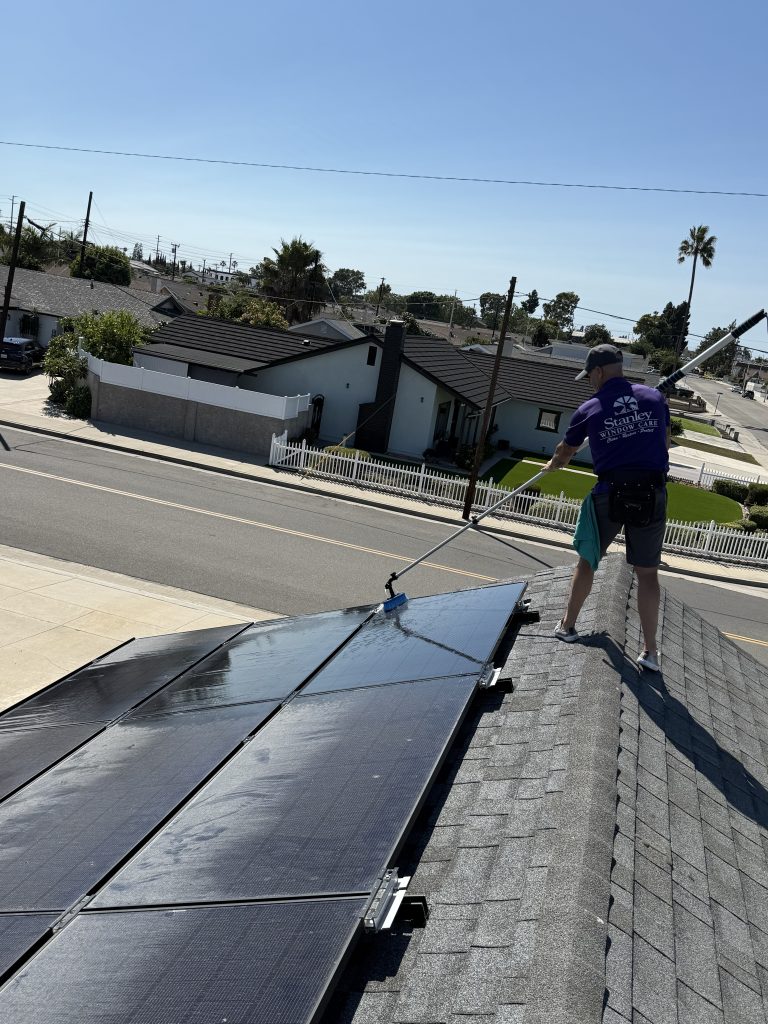
At Stanley Window Care, we provide professional solar panel cleaning throughout South Orange County, helping homeowners safely remove the buildup that ordinary rainfall often leaves behind.
Why Southern California Rain Does Not Fully Clean Solar Panels
It is easy to assume that solar panels should be relatively maintenance-free because they are installed outdoors and periodically exposed to rain. The problem is that rainfall and professional cleaning accomplish two very different things.
Rain essentially provides a surface rinse. When enough rain falls, some loose dust may be carried toward the bottom edge of a panel. However, contaminants that have adhered to the glass can remain.
Southern California’s climate makes this particularly noticeable. Long stretches of sunny, dry weather give dust and other airborne particles considerable time to settle onto rooftop solar arrays.
Common contaminants include:
- Dust and fine soil particles
- Pollen
- Bird droppings
- Tree residue and organic debris
- Airborne pollution
- Smoke and fine particulate matter
- Mineral residue
- Dried water spots
- Leaves and plant debris
- Insect residue
Once these materials have adhered to the glass, a rainstorm may not be enough to remove them completely.
Rain Can Turn Existing Dust Into Stubborn Residue
One of the biggest misconceptions about solar panel maintenance is that any amount of rain automatically results in cleaner panels.
Imagine a panel that has been exposed to several weeks of dry Southern California weather. A thin film of dust has accumulated across the glass. A light rain arrives and wets the surface without completely washing everything away.
The water mixes with the existing dirt.
When the weather clears and the panels dry, some of that contamination can remain behind as a visible film or spotting.
This is similar to what happens when a dusty vehicle receives a small amount of rain. The vehicle may initially look cleaner while wet, but once it dries, spots and dirty streaks frequently remain.
Solar panels can experience the same problem.
Southern California’s Long Dry Seasons Make Solar Panel Cleaning Important
Southern California provides excellent conditions for solar energy, but the region’s climate also creates conditions that encourage rooftop dust accumulation.
Homes throughout Orange County and South Orange County can experience extended periods with little or no measurable rain. During these periods, solar panels remain exposed to airborne particles every day.
Properties near busy roads may experience additional road dust and pollution. Homes near landscaping, trees, open hillsides, construction activity, or coastal areas can encounter different forms of airborne residue.
By the time substantial rain finally arrives, the panels may already have accumulated a noticeable layer of contamination.
This is why relying exclusively on the weather is not a dependable solar panel cleaning strategy.
Does Heavy Rain Clean Solar Panels Better Than Light Rain?
A strong rainstorm can remove more loose debris than a light drizzle. However, even substantial rainfall should not necessarily be considered a replacement for cleaning.
Heavy rain may help remove:
- Loose dust
- Small amounts of pollen
- Light surface debris
- Some dirt that has not bonded to the glass
However, rain is considerably less effective against stubborn contaminants such as dried bird droppings, mineral spotting, sticky plant residue, and heavily accumulated grime.
The angle and design of the solar array also influence how effectively water carries debris away.
Rainwater moves according to gravity. Professional cleaning, by comparison, is performed specifically to remove contamination across the panel surface.
Bird Droppings Are a Major Reason Rain Is Not Enough
Bird droppings are among the most obvious contaminants found on rooftop solar panels.
Once bird droppings dry under the Southern California sun, they can become firmly attached to the panel surface. A short rainstorm may soften the material without completely removing it.
This can leave portions of the panel visibly dirty even after rain.
Properties with nearby trees, roof peaks, utility lines, antennas, fences, or other common bird-perching locations may experience bird contamination more frequently.
Professional cleaning allows these concentrated deposits to be addressed rather than waiting for weather conditions to eventually remove them.
Rainwater Can Leave Water Spots on Solar Panels
Rain itself is relatively low in dissolved minerals when it begins falling, but the final drying process on a dirty rooftop surface is more complicated.
Water can interact with dust, dirt, roofing material, environmental particles, and existing deposits before evaporating.
When droplets dry, residue may remain.
This is particularly noticeable when water is allowed to repeatedly wet and dry on glass.
Professional solar panel cleaning is intended to leave the glass significantly cleaner and more uniform than an uncontrolled rain rinse.
Why Solar Panels Can Still Look Dirty After a Rainstorm
Homeowners sometimes inspect their panels following a storm and are surprised to see that they still appear dirty.
Several conditions can cause this.
First, the rainfall may not have been heavy enough to carry accumulated dirt completely off the panels.
Second, some contaminants are adhered to the glass rather than simply resting on top of it.
Third, water can redistribute dust instead of eliminating it. As water flows toward the lower edge of the panel, it can carry particles with it and create areas of concentrated residue.
Finally, once the panels dry, remaining contamination becomes much easier to see.
The result can be streaking, spotting, dirty edges, or an uneven film even though the solar array was recently exposed to rain.
How Often Should Solar Panels Be Cleaned in Southern California?
There is no single cleaning schedule appropriate for every property.
The right frequency depends heavily on the environment surrounding the home.
Solar panels may require more frequent attention when a property is exposed to:
- Heavy dust
- Nearby construction
- Frequent bird activity
- Trees or vegetation
- Road traffic
- Agricultural activity
- Hillside dust
- Wildfire smoke or ash
- Long periods without rain
For many Southern California homeowners, inspecting the panels periodically and scheduling cleaning when visible buildup develops is more practical than assuming rainfall will handle the maintenance.
A professional can also help determine whether the panels have accumulated enough contamination to justify cleaning.
Can You Clean Solar Panels Yourself?
Solar panel cleaning may appear simple from ground level, but rooftop work introduces serious safety concerns.
Solar arrays are frequently installed on sloped roofs, second-story structures, tile roofing, and difficult-to-access areas. Wet surfaces can further increase the risk of slipping.
There is also the possibility of accidentally damaging roofing materials or solar equipment when walking around an unfamiliar rooftop.
For these reasons, homeowners should carefully consider whether attempting rooftop solar panel cleaning themselves is worth the risk.
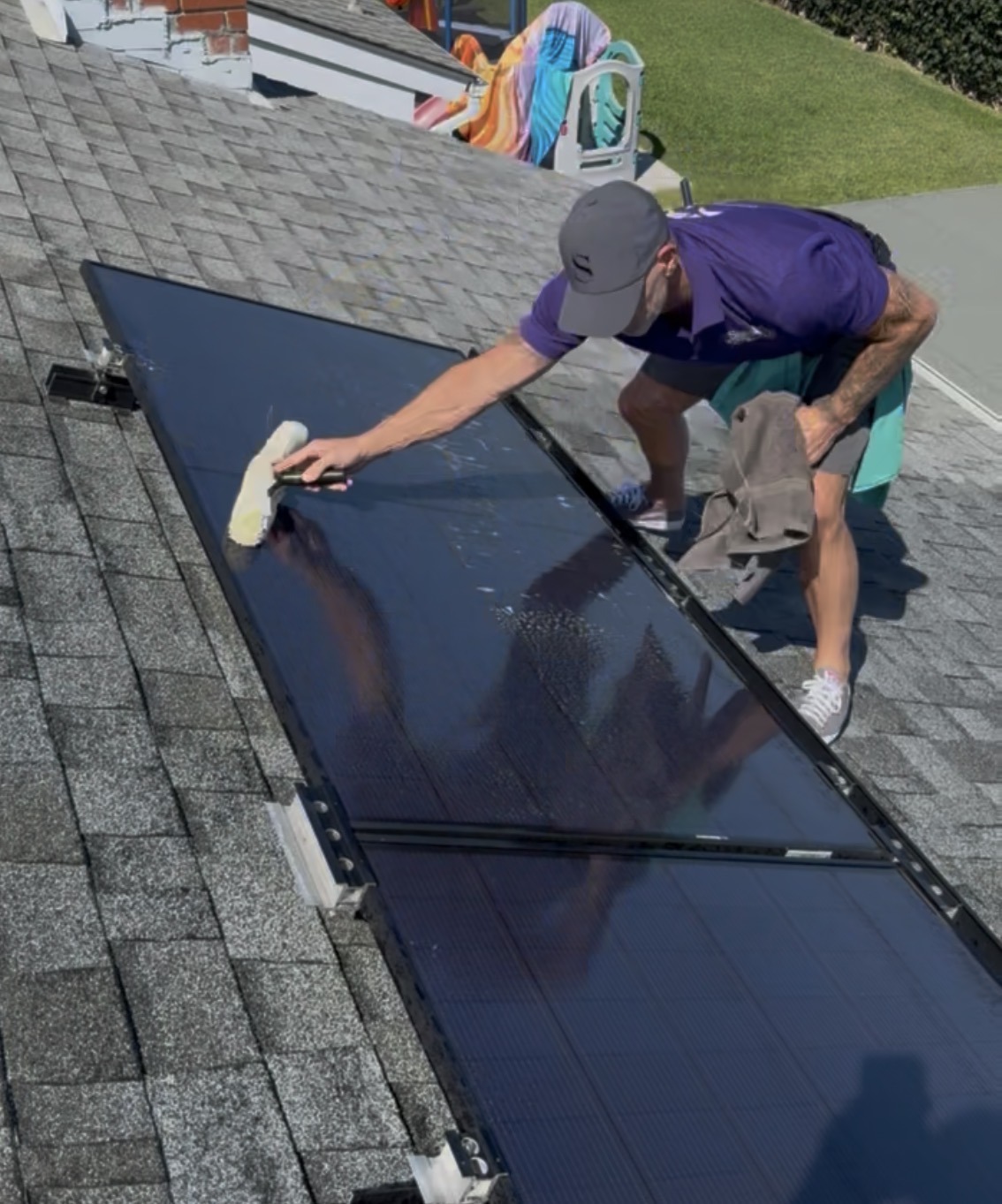
Professional cleaning provides a way to address dirty panels without homeowners unnecessarily putting themselves in a dangerous rooftop situation.
Why Proper Solar Panel Cleaning Methods Matter
Solar panels should be treated differently from many ordinary exterior surfaces.
Aggressive scrubbing, abrasive materials, harsh chemicals, or inappropriate cleaning techniques can create unnecessary risks.
The objective is straightforward: remove contamination from the glass while treating the solar equipment carefully.
Professional solar panel cleaning focuses on contaminants that rainwater cannot reliably remove while avoiding unnecessarily aggressive methods.
This is especially important when dealing with panels that have accumulated months of environmental buildup.
Solar Panel Cleaning After Wildfires and Heavy Smoke
Southern California occasionally experiences wildfire conditions that can introduce smoke, ash, and fine airborne particles across large areas.
Even properties located significant distances from an active fire can experience falling ash or fine particulate matter.
This material can settle on roofs and solar panels.
A small amount of rain following smoky conditions does not necessarily mean the panels are clean. Water may combine with accumulated particles and leave residue behind after drying.
Following periods of significant ash or environmental contamination, homeowners may want to visually inspect their solar panels from a safe location and determine whether professional cleaning is appropriate.
Solar Panels Near Trees May Need More Frequent Cleaning
Trees provide shade and beauty, but they can also increase the amount of debris reaching rooftop solar panels.
Depending on the surrounding vegetation, panels may be exposed to:
pollen, leaves, seeds, blossoms, sap-like residue, insects, bird activity, and fine organic material.
Rain may remove some loose material, but sticky or dried organic contaminants frequently remain.
Homes surrounded by mature landscaping may therefore require a different maintenance schedule than properties with very little nearby vegetation.
Solar Panels Near Roads and Construction Areas
Traffic and construction can also influence how quickly panels become dirty.
Homes near major streets, active developments, earth-moving projects, or areas with exposed soil can experience significant airborne dust.
These fine particles eventually settle on horizontal and angled exterior surfaces, including solar panels.
When Southern California goes through an extended dry period, the accumulation can continue for months.
Waiting for rain may provide only temporary improvement rather than a complete cleaning.
Does Cleaning Solar Panels Improve Solar Production?
The effect of cleaning varies because every solar installation and level of contamination is different.
A lightly dusty panel will not necessarily behave the same way as a panel covered with substantial dirt, bird droppings, or concentrated debris.
What is clear is that solar panels are designed to receive sunlight through their exposed surface. Keeping that surface free from excessive contamination is a sensible part of maintaining an exterior solar installation.
Homeowners who want to evaluate actual production changes should compare their solar monitoring data before and after cleaning while accounting for variables such as weather, season, temperature, shading, and daily sunlight conditions.
When Should You Schedule Professional Solar Panel Cleaning?
Instead of waiting for rain, consider the actual condition of the panels.
Professional cleaning may be appropriate when you notice:
- Visible layers of dust
- Numerous bird droppings
- Significant spotting
- Dirt concentrated around panel edges
- Pollen accumulation
- Organic debris
- Ash or smoke residue
- Panels that remain visibly dirty after rainfall
It can also make sense to schedule cleaning after an unusually long dry period when environmental buildup has had months to accumulate.
Why Southern California Solar Panels Need More Than Rain
The fundamental problem with relying on rain is inconsistency.
Homeowners cannot control when it rains, how much rain falls, how long it lasts, or whether it is sufficient to remove existing contamination.
Professional cleaning is deliberate.
Instead of hoping weather eventually removes the buildup, cleaning specifically targets the material that has accumulated on the panel surface.
This distinction becomes particularly important in Southern California, where long periods of dry weather are normal.
Professional Solar Panel Cleaning in South Orange County
At Stanley Window Care, we understand the unique exterior cleaning challenges homeowners face throughout South Orange County.
Since 1997, we have provided professional exterior cleaning services with an emphasis on careful workmanship and dependable customer service. With more than 28 years of experience, we understand that exterior glass and solar surfaces can accumulate far more than ordinary dust.
Our solar panel cleaning service is designed for homeowners who want their panels properly cleaned rather than simply waiting for the next Southern California rainstorm.
We serve communities throughout South Orange County, including areas such as Newport Beach, Newport Coast, Corona del Mar, Laguna Beach, Laguna Niguel, Dana Point, Mission Viejo, San Clemente, Ladera Ranch, and Coto de Caza.
Rain vs. Professional Solar Panel Cleaning
Rainfall can certainly help.
A substantial storm may wash away loose dust and make panels temporarily appear cleaner. However, rain should be viewed as an occasional natural rinse, not a comprehensive cleaning method.
Professional solar panel cleaning is better suited for removing the stubborn contamination that weather leaves behind.
The difference becomes particularly noticeable when panels have been exposed to months of dry conditions, birds, trees, traffic, construction dust, or environmental pollution.
Frequently Asked Questions About Rain and Solar Panel Cleaning
Will Rain Wash Dust Off Solar Panels?
Rain can remove some loose dust, particularly during a strong and sustained storm. However, it may not remove all accumulated dirt, especially when the dust has combined with pollen, pollution, bird droppings, or other residue.
Why Are My Solar Panels Spotted After It Rains?
Spotting can occur when water mixes with existing dirt and environmental contaminants and then evaporates. Remaining particles can create visible spots, streaks, or residue.
Should I Clean Solar Panels During the Rainy Season?
The condition of the panels is more important than the season. If panels remain visibly contaminated after rain, professional cleaning may still be appropriate.
Does Light Rain Clean Solar Panels?
Light rain is generally less effective because it may wet accumulated dirt without generating enough water flow to carry it completely away.
Can Bird Droppings Wash Off in Rain?
Fresh contamination may partially rinse away, but dried bird droppings can remain attached even after rainfall.
Should I Wait for Rain Instead of Scheduling Solar Panel Cleaning?
If the panels are already visibly dirty, waiting for rain does not guarantee they will become clean. Southern California can also experience extended dry periods, making rainfall an unreliable maintenance strategy.
Schedule Solar Panel Cleaning With Stanley Window Care
Rain is helpful, but it is not a substitute for proper solar panel cleaning.
Southern California’s combination of sunshine, dry weather, dust, birds, landscaping, traffic, pollution, and occasional wildfire conditions means rooftop panels can accumulate stubborn contamination between storms.
At Stanley Window Care, we provide professional solar panel cleaning for homeowners throughout South Orange County. Since 1997, we have built our reputation around careful service and professional exterior cleaning.
If your solar panels still look dusty, spotted, or dirty after the latest rain, they may need more than another storm.
Contact Stanley Window Care today to schedule professional solar panel cleaning in South Orange County and keep your panels clean throughout Southern California’s long dry seasons.