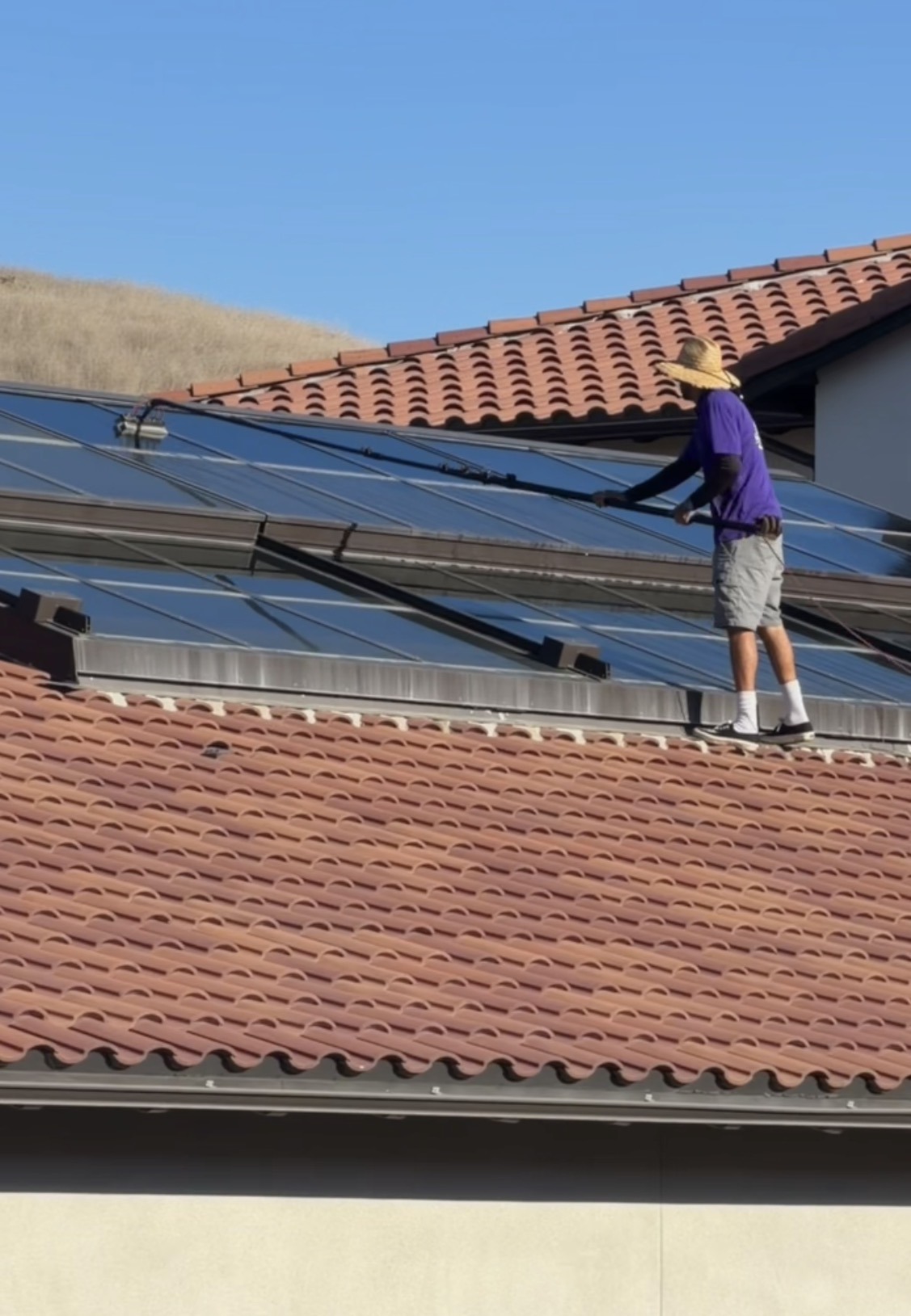
How Often Should You Clean Your Solar Panels?
Solar panels are a long-term investment designed to convert sunlight into usable electricity, but keeping the surface of those panels clean is an important part of maintaining their performance. Dust, pollen, bird droppings, airborne debris, and other contaminants can gradually build up on the glass and reduce the amount of sunlight reaching the photovoltaic cells.
At Stanley Window Care, we provide professional solar panel cleaning throughout Orange County and understand how Southern California’s dry weather, limited rainfall, coastal conditions, landscaping, and extended sunny seasons can contribute to buildup.
For many Orange County properties, we recommend professional solar panel cleaning approximately every 6 months, although some systems may benefit from cleaning every 3 to 4 months, while panels in relatively clean locations may require service only once or twice per year.
Featured Answer: How Often Should Solar Panels Be Cleaned?
Most homeowners should consider cleaning their solar panels every 6 months, or about twice per year. However, solar panels exposed to heavy dust, nearby trees, bird activity, construction, agricultural areas, traffic pollution, or coastal residue may need cleaning every 3 to 4 months. The ideal schedule depends on the location of the property, roof conditions, panel angle, surrounding environment, and how quickly contaminants accumulate.
Rather than relying exclusively on a fixed schedule, we recommend periodically inspecting your solar panels and watching for visible buildup or unexpected changes in solar production.
Why Solar Panels Need Regular Cleaning
Solar panels work best when sunlight can reach their surface with minimal obstruction. Although panels are designed for outdoor exposure, that does not mean they remain clean automatically.
Over time, a layer of contamination can develop from:
- Dust and airborne dirt
- Pollen
- Bird droppings
- Tree debris
- Leaves and organic material
- Insect residue
- Traffic-related pollution
- Construction dust
- Coastal airborne residue
- Mineral deposits from water
A panel does not necessarily have to look extremely dirty before buildup begins interfering with the amount of sunlight reaching its surface.
Regular solar panel cleaning helps maintain a cleaner, more uniform surface and prevents contaminants from remaining on the panels for extended periods.
How Often Should You Clean Solar Panels in Orange County?
For many Orange County homes, a practical starting point is solar panel cleaning twice per year.
Southern California receives relatively little rainfall compared with many other parts of the country. Long stretches of dry weather allow dust and debris to remain on rooftop solar arrays for months.
The correct schedule can vary considerably between properties.
A home surrounded by mature trees may experience significantly more pollen, leaves, bird activity, and organic debris than a home in a newer neighborhood with limited landscaping. Likewise, properties near busy roads, ongoing construction, open land, or the coast may experience different forms of contamination.
We generally recommend considering the following schedule:
| Property Conditions | Suggested Cleaning Frequency |
|---|---|
| Typical residential property | Every 6 months |
| Heavy dust exposure | Every 3–4 months |
| Significant bird activity | Every 3–4 months or as needed |
| Near construction | Every 3–4 months |
| Near mature trees | Every 3–6 months |
| Coastal exposure | Every 3–6 months |
| Relatively clean environment | Every 6–12 months |
These intervals are general guidelines. The actual condition of the panels should ultimately determine when cleaning is appropriate.
Is Cleaning Solar Panels Once a Year Enough?
For some homes, annual solar panel cleaning may be sufficient, particularly when the panels are installed at a substantial angle and the property experiences relatively little dust, bird activity, or surrounding vegetation.
However, once-a-year cleaning can be too infrequent for many Southern California properties.
If panels develop a noticeable layer of dust only a few months after cleaning, waiting an entire year means they spend a significant portion of that year covered with contamination.
We prefer to evaluate how quickly the panels become dirty and establish a cleaning schedule based on the actual property rather than assuming every solar system should receive identical maintenance.
Do Solar Panels Clean Themselves When It Rains?
Rain can remove some loose surface dust, but rain should not be considered a replacement for professional solar panel cleaning.
Anyone who has looked at a vehicle after a light Southern California rain has probably seen the problem. Rainwater combines with existing dust and contaminants, moves them around, and can leave spotting or residue behind once the water evaporates.
Solar panels can experience a similar effect.
Rain may not fully remove:
- Bird droppings
- Sticky pollen
- Heavy dust
- Mineral deposits
- Organic residue
- Baked-on contamination
- Dirt collected around panel edges
Extended periods without meaningful rainfall also allow contamination to continue accumulating.
Does Dirty Solar Glass Affect Solar Panel Performance?
The photovoltaic cells inside a solar panel depend on incoming sunlight. Anything that obstructs that sunlight has the potential to interfere with energy production.
A very thin layer of dust may have a relatively small effect, while heavier or uneven contamination can create a more significant obstruction.
Bird droppings can be particularly problematic because they create concentrated areas of coverage rather than a uniform layer of light dust.
The amount of performance affected by dirt varies according to the type and severity of contamination, panel design, weather, installation angle, location, and other conditions. For that reason, we avoid promising a specific percentage increase after every cleaning.
Our objective is straightforward: remove unnecessary contamination from the panel surface so the system has clean exposure to sunlight.
Signs Your Solar Panels May Need Cleaning
You do not always need to wait until your normal maintenance date. Several signs can indicate that it is time to schedule professional solar panel cleaning.
Visible Dust Across the Panels
If the glass has developed a noticeable gray, tan, or dusty appearance, contaminants are accumulating on the surface.
Bird Droppings
Bird droppings are highly visible and can cover concentrated sections of individual panels. Properties with nearby trees, roof peaks, utility lines, or frequent bird activity may encounter this problem more often.
Uneven Dirty Areas
Some sections of a solar array can become dirtier than others. Roof design, wind direction, nearby trees, and panel positioning can all influence how contamination accumulates.
Debris Along Panel Edges
Leaves, pollen, dirt, and other debris may gather around the lower edges of tilted panels.
Unexpected Production Changes
Solar production naturally changes with weather and seasons. However, if you notice an unexplained decrease and the panels are visibly dirty, cleaning may be worth considering as part of your system maintenance.
When Is the Best Time of Year to Clean Solar Panels?
There is no single month that works for every Orange County property. A spring and fall solar panel cleaning schedule can be convenient because it spaces maintenance approximately six months apart.
Spring cleaning can remove contaminants accumulated through winter and seasonal pollen. A later cleaning can address dust and debris accumulated during Southern California’s long, dry months.
Properties that become dirty more quickly may benefit from an additional cleaning during the year.
The goal is not to select an arbitrary date. It is to prevent excessive contamination from remaining on the panels for long periods.
Should You Clean Solar Panels More Often During Dry Weather?
Extended dry weather can increase the need for cleaning because there is little natural rinsing of loose surface dust.
Orange County frequently experiences long periods with limited rainfall. During those stretches, panels can collect layer after layer of airborne particles.
Homes near dry hillsides, open land, landscaping projects, construction, and heavily traveled roads may experience even faster accumulation.
If your panels look dusty only a few months after service, moving from an annual schedule to cleaning every six months may make more sense.
How Nearby Trees Affect Solar Panel Cleaning Frequency
Trees provide shade and attractive landscaping, but they can also contribute to solar panel contamination.
Depending on the species and season, nearby trees may introduce:
- Pollen
- Leaves
- Seeds
- Sap-like residue
- Small branches
- Bird activity
- Insect activity
- Organic debris
Homes with solar panels directly beneath or adjacent to mature trees may therefore require more frequent inspection and cleaning.
We often recommend evaluating these systems every few months rather than automatically waiting an entire year.
How Bird Activity Changes Your Solar Panel Cleaning Schedule
Bird activity is another important consideration.
Unlike ordinary dust, bird droppings create concentrated areas of contamination. Rain may soften some deposits but does not guarantee complete removal.
If birds regularly perch near your solar array, inspect the panels periodically. A system experiencing frequent bird contamination may need professional cleaning more often than a neighboring home without the same problem.
Do Coastal Orange County Solar Panels Need More Frequent Cleaning?
Coastal properties can experience environmental conditions different from inland neighborhoods.
Homes in communities closer to the ocean may encounter combinations of airborne moisture, fine particles, coastal residue, dust, and general environmental contamination.
Depending on the property’s exact location and exposure, coastal solar panel cleaning every 3 to 6 months may be appropriate.
The best schedule is determined by observing how quickly the panels actually become dirty.
Why Professional Solar Panel Cleaning Is Different From Washing a Roof
Solar panels should be treated as specialized exterior surfaces.
Aggressive pressure is unnecessary and can create avoidable risks. Professional cleaning should focus on safely removing surface contamination without treating solar panels like concrete, siding, or another pressure-washing surface.
At Stanley Window Care, we approach solar panel cleaning with methods appropriate for the panel surface and surrounding roof environment.
The objective is to achieve clean panels without using unnecessarily aggressive cleaning techniques.
Can You Pressure Wash Solar Panels?
We do not recommend treating solar panels like a pressure-washing surface.
High-pressure water is designed for durable exterior materials under appropriate circumstances. Solar panels contain glass, seals, electrical components, mounting systems, and connections that should be treated carefully.
Cleaning solar panels does not require blasting them with high pressure.
A controlled professional cleaning process is a better approach.
Why Tap Water Can Leave Spots on Solar Panels
One of the problems homeowners encounter when attempting to clean solar panels themselves is water spotting.
Tap water contains dissolved minerals. When water droplets evaporate, those minerals can remain on the glass.
Southern California is known for areas with relatively hard water, making mineral spotting an important consideration for exterior glass and solar surfaces.
Simply spraying panels with a garden hose and allowing them to dry does not necessarily produce a clean, spot-free result.
Should Solar Panels Be Cleaned When They Look Dirty?
Yes. Visible contamination is one of the simplest indicators that cleaning may be appropriate.
A maintenance schedule provides a useful baseline, but the actual appearance of the panels matters more.
If your system normally receives service every six months but becomes heavily covered with dust or bird droppings after three months, there is little benefit in waiting another three months simply because the calendar says so.
Likewise, a relatively protected system that remains clean may not require unusually frequent service.
How Often Should Commercial Solar Panels Be Cleaned?
Commercial solar arrays should also be evaluated according to environmental exposure.
Commercial properties may experience substantial contamination from:
- Parking lots
- Vehicle traffic
- Nearby industrial activity
- HVAC equipment
- Construction
- Large flat-roof environments
- Airborne dust
- Birds
- Landscaping
Larger systems also represent a substantial investment, making routine inspection and maintenance particularly important.
A quarterly, semiannual, or customized solar panel cleaning schedule may be appropriate depending on the facility.
Can Regular Solar Panel Cleaning Prevent Heavy Buildup?
Routine cleaning can help prevent contamination from remaining on the surface long enough to become increasingly difficult to remove.
This is especially relevant with bird droppings, environmental residue, and mineral deposits.
Maintaining a reasonable schedule is generally preferable to allowing panels to become severely dirty and then attempting to restore them after years of neglect.
For many homeowners, twice-yearly cleaning provides a practical maintenance routine.
How Do You Know the Right Cleaning Schedule for Your Home?
Start by inspecting your panels approximately three months after they have been professionally cleaned.
If they remain relatively clean, check again around the six-month mark.
If substantial contamination is already visible after three months, consider a quarterly schedule. If they remain reasonably clean at six months, twice-yearly service may be appropriate.
This approach allows you to create a schedule based on your property’s actual conditions.
Frequently Asked Questions About Solar Panel Cleaning
How often should residential solar panels be cleaned?
For many homes, every six months is a practical starting point. Properties with heavier environmental contamination may require cleaning every three to four months.
Can I clean my solar panels once per year?
Possibly. Annual cleaning may be sufficient for relatively clean locations, but homes exposed to substantial dust, trees, birds, construction, traffic, or coastal conditions may benefit from more frequent service.
Does rain clean solar panels?
Rain can rinse away some loose dust, but it does not reliably remove bird droppings, stubborn contamination, mineral residue, or accumulated grime.
Should solar panels be pressure washed?
Solar panels should not be treated like traditional pressure-washing surfaces. Controlled cleaning methods appropriate for solar panels are preferable.
When should I schedule solar panel cleaning?
Schedule service when you notice visible contamination or establish a regular maintenance interval based on how quickly your panels become dirty. For many Orange County homeowners, spring and fall provide a convenient twice-yearly schedule.
Do dusty areas require more frequent solar panel cleaning?
Yes. Homes exposed to open land, construction, dry landscaping, road dust, and other airborne particles may need cleaning more frequently.
Can bird droppings be removed from solar panels?
Professional cleaning can address bird droppings and other surface contamination. Properties experiencing frequent bird activity should inspect their panels more regularly.
Professional Solar Panel Cleaning in Orange County
Solar panels spend every day exposed to Southern California’s outdoor environment. Keeping them clean is a simple but important part of maintaining the system.
At Stanley Window Care, we provide professional solar panel cleaning for homeowners throughout our Orange County service area. With decades of experience caring for exterior glass and residential properties, we understand the importance of using careful techniques around roofs, glass, frames, and solar equipment.
For most homeowners, we recommend beginning with solar panel cleaning approximately every six months and adjusting the schedule according to the property’s conditions.
Homes with significant dust, bird activity, trees, construction, or coastal exposure may benefit from cleaning every three to four months. Cleaner properties may be able to extend the interval.
Keep Your Solar Panels Clean With Stanley Window Care
If your solar panels are covered with dust, pollen, bird droppings, or environmental residue, there is no reason to wait until they become heavily soiled.
Stanley Window Care has served Orange County homeowners since 1997, providing professional exterior cleaning services with an emphasis on careful workmanship and dependable service.
We can help remove accumulated surface contamination and establish a practical cleaning schedule based on your home’s environment.
For homeowners wondering, “How often should I clean my solar panels?”, the simplest answer is:
Start with professional cleaning every six months, inspect the panels between services, and increase the frequency when your property’s environment causes faster buildup.
A consistent schedule helps keep your panels clean, your rooftop system looking well maintained, and unnecessary dirt and debris from accumulating year after year.