Can You Pressure Wash Solar Panels?
Featured Answer: Can You Pressure Wash Solar Panels?
No, we generally do not recommend pressure washing solar panels. Although solar panels are designed to withstand rain, wind, and outdoor conditions, concentrated high-pressure water can place unnecessary stress on the glass, seals, frames, mounting components, wiring, and other parts of a solar energy system. It may also conflict with the cleaning or maintenance recommendations provided by the panel manufacturer.
At Stanley Window Care, we recommend using a controlled, low-pressure solar panel cleaning method designed to remove dust, dirt, pollen, bird droppings, mineral residue, and other buildup without subjecting the panels to the force produced by a pressure washer.
For homeowners in Orange County and South Orange County, California, professional solar panel cleaning can be especially useful because panels are regularly exposed to dry weather, airborne dust, coastal residue, landscaping debris, and periods with limited rainfall.
Why We Do Not Recommend Pressure Washing Solar Panels
A pressure washer is extremely useful for certain exterior cleaning projects, but that does not mean it is appropriate for every outdoor surface.
Solar panels are electrical energy-producing components rather than ordinary roofing materials. A typical residential installation includes tempered glass, aluminum framing, seals, electrical connections, wiring, mounting hardware, and other components that should be treated carefully.
The concern is not simply whether the glass can withstand water. The primary issue is the concentrated force of pressurized water and where that water is directed.
A powerful stream can potentially force water into areas where it would not normally reach during rainfall or conventional low-pressure cleaning. High pressure can also unnecessarily stress seals, edges, frames, mounting components, and surrounding roofing materials.
For these reasons, we believe solar panel cleaning should focus on effective contaminant removal with the least aggressive method necessary.
Can a Pressure Washer Damage Solar Panels?
Potentially, yes. The exact risk depends on the solar panel system, equipment, water pressure, nozzle, distance from the panels, condition of the installation, and manufacturer requirements.
Possible concerns associated with inappropriate pressure washing include:
- Damage or unnecessary stress to panel seals and edges
- Water intrusion into vulnerable areas
- Stress on frames and mounting components
- Damage to electrical connections or surrounding equipment
- Damage to roofing materials around the solar array
- Scratching caused by improper tools or cleaning techniques
- Problems associated with cleaning extremely hot panels
- Possible warranty concerns when manufacturer cleaning instructions are not followed
Even when visible damage does not occur immediately, using excessive pressure provides little advantage when solar panels can normally be cleaned effectively using gentler methods.
What Is the Best Way to Clean Solar Panels?
We recommend a low-pressure, non-abrasive cleaning process appropriate for the specific solar installation.
The objective is to loosen and remove contaminants from the panel surface without exposing the system to unnecessary pressure or abrasive scrubbing.
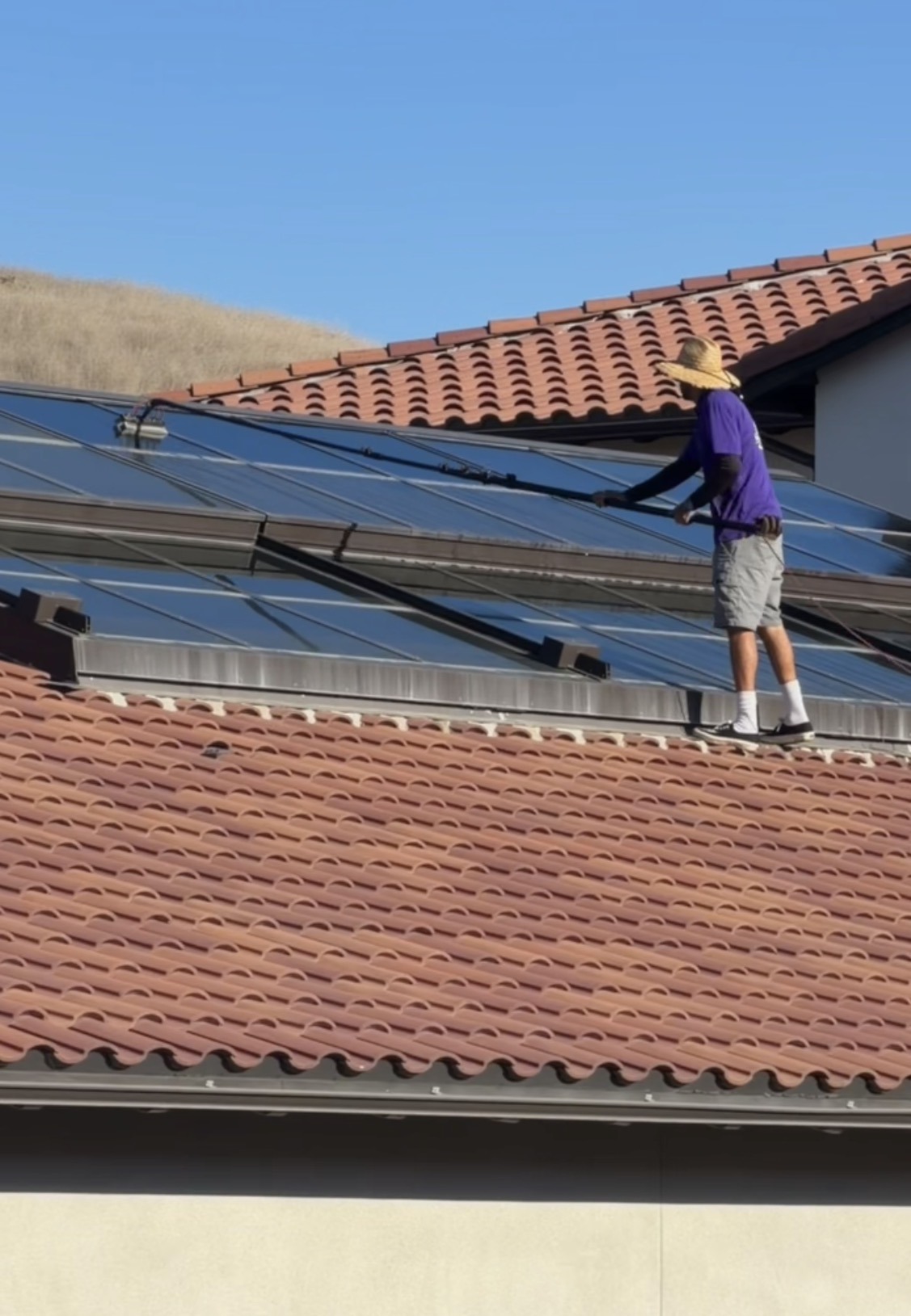
Depending on the installation and manufacturer recommendations, professional solar panel cleaning may involve purified or appropriately treated water, specialized solar panel cleaning equipment, soft brushes or cleaning tools, and controlled water application.
The exact approach should always take the panel manufacturer’s instructions into consideration.
At Stanley Window Care, we approach solar panel cleaning differently from driveway or concrete pressure washing. Solar panels require a more delicate cleaning process.
Why Solar Panels Become Dirty in Orange County
Southern California’s climate can be excellent for solar energy production, but it does not mean solar panels remain naturally clean.
In Orange County, panels can accumulate layers of contaminants over time, including:
- Airborne dust
- Pollen
- Bird droppings
- Tree debris
- Leaves
- Insect residue
- Coastal residue
- Construction dust
- Landscaping debris
- Pollution particles
- Mineral deposits from irrigation or hard water
Homes near busy roads, construction areas, trees, hillsides, landscaped communities, and coastal environments may experience particularly noticeable accumulation.
Because Southern California can experience extended dry periods, contaminants may remain on panel surfaces between significant rain events.
Does Rain Clean Solar Panels?
Rain can remove some loose surface dust, but rain should not be considered a complete solar panel cleaning method.
The easiest comparison is a home’s exterior windows.
Rain may rinse away some loose debris from glass, but it does not necessarily remove stuck-on contamination, bird droppings, mineral residue, pollen, or grime. Solar panel glass can experience similar buildup.
Rainwater can also move dirt across the panel and leave contaminants concentrated near edges as the water dries.
Therefore, a panel may look somewhat cleaner after rain while still having substantial surface contamination.
Can Dirty Solar Panels Produce Less Electricity?
Yes. Solar panels depend on sunlight reaching the photovoltaic cells beneath the protective glass. When dirt, dust, bird droppings, leaves, or other contaminants obstruct portions of the panel, they can reduce the amount of sunlight reaching the active surface.
The actual production impact varies considerably.
Factors include the amount and type of contamination, panel angle, location, weather conditions, rainfall, surrounding vegetation, system design, and whether the debris creates localized shading.
A thin, relatively uniform layer of dust may have a different effect than concentrated bird droppings or leaves covering part of a panel.
For this reason, solar panel cleaning should be considered routine system maintenance rather than a guaranteed percentage increase in electricity production.
Can You Use a Garden Hose on Solar Panels?
A garden hose is considerably different from a pressure washer because it normally delivers water at much lower pressure.
However, homeowners should still follow the solar panel manufacturer’s cleaning instructions.
Water should not be aggressively directed into electrical equipment, connectors, damaged seals, roof penetrations, or other vulnerable areas.
Water quality should also be considered.
Orange County is known for areas with relatively hard water. If mineral-rich water is sprayed onto hot solar panels and allowed to evaporate, it can leave mineral spotting or residue behind.
That means simply spraying panels with a hose and allowing them to air-dry may not produce the clean result homeowners expect.
Can Hard Water Damage or Spot Solar Panels?
Hard water contains dissolved minerals. When the water evaporates, those minerals can remain on the glass surface.
Repeated wetting and drying can produce visible spotting or mineral deposits.
This is one reason professional cleaning techniques often emphasize water quality and controlled drying.
At Stanley Window Care, our extensive experience cleaning exterior glass throughout Orange County has shown us how quickly mineral deposits can become noticeable on glass surfaces.
Solar panel glass should therefore be treated with the same attention to water quality and residue prevention.
Should You Use Soap to Clean Solar Panels?
Homeowners should avoid assuming that ordinary household soap, dish detergent, glass cleaner, or strong chemical cleaner is appropriate for solar panels.
Some products can leave a film or residue on the glass. Others may not be compatible with panel coatings, seals, frames, or manufacturer requirements.
A solar panel does not need to smell clean or be covered with suds to be effectively cleaned.
We prefer a minimal-residue approach using appropriate equipment and methods rather than unnecessarily aggressive chemicals.
Manufacturer instructions should take priority whenever a specific cleaning solution or procedure is required.
Can You Use a Brush on Solar Panels?
Only an appropriate soft, non-abrasive cleaning tool should be considered.
Solar panels should never be scrubbed with abrasive pads, stiff brushes, metal tools, scrapers, or other equipment that could scratch or damage the surface.
Another common mistake is scrubbing dry dirt across dry glass.
Dust and grit can contain abrasive particles. Dragging those particles across the panel can create unnecessary friction.
A professional cleaning process is designed to loosen contamination and remove it without aggressive abrasion.
Should Solar Panels Be Cleaned When They Are Hot?
Cleaning extremely hot solar panels is generally not ideal.
Solar panels exposed to direct Southern California sunlight can become very hot. Applying significantly cooler water to a hot surface may create unnecessary thermal stress.
Hot panels also cause water to evaporate rapidly, increasing the likelihood of spotting and making effective cleaning more difficult.
Whenever practical, solar panels are better cleaned under cooler conditions, while also following applicable manufacturer recommendations.
How Often Should Solar Panels Be Professionally Cleaned?
There is no single cleaning schedule appropriate for every Orange County property.
Some systems remain relatively clean for long periods, while others accumulate contamination quickly.
The appropriate interval can depend on:
Location: Homes near dusty roads, open land, construction, or coastal areas may experience faster buildup.
Trees: Nearby trees can contribute pollen, leaves, sap, and bird activity.
Birds: Frequent bird activity can create concentrated droppings that rain may not remove effectively.
Panel angle: The slope of the panels affects how easily rain carries loose debris away.
Irrigation: Sprinklers reaching the roof or panels can contribute to mineral deposits.
Weather: Extended dry periods can allow dust and other contaminants to accumulate.
Instead of automatically cleaning panels according to an arbitrary calendar, we recommend monitoring their physical condition and following manufacturer maintenance recommendations.
Why Bird Droppings Are a Problem on Solar Panels
Bird droppings are different from ordinary dust because they can adhere strongly to the panel surface.
Rain may soften the contamination without completely removing it.
Bird droppings can also create localized obstruction, preventing sunlight from reaching a specific portion of the panel.
Aggressively blasting the contamination with a pressure washer is not necessary. A controlled cleaning method can soften and remove stuck-on debris while minimizing stress on the panel.
Can You Walk on Solar Panels to Clean Them?
We do not recommend walking on solar panels.
Even if the glass appears strong enough to support weight, concentrated pressure can damage panels or components. Walking across a roof also introduces significant fall hazards and can potentially damage roofing materials.
Solar arrays can make roof navigation more difficult because they reduce available walking space and may create obstacles around mounting hardware and electrical equipment.
Professional cleaners use appropriate access methods and equipment based on the property and installation.
Is DIY Solar Panel Cleaning Safe?
Cleaning panels installed close to ground level is very different from cleaning an array installed on a steep or multi-story roof.
For rooftop solar systems, the greatest risk may not be the cleaning process itself. It may be roof access and fall exposure.
Wet roofs can become slippery. Hoses can create trip hazards. Solar panels can restrict movement. Roof edges may be difficult to see while concentrating on cleaning.
Homeowners should never compromise personal safety simply to remove dust from a solar array.
When safe access is difficult, professional solar panel cleaning is the more practical option.
Pressure Washing vs. Professional Solar Panel Cleaning
Pressure washing relies primarily on mechanical force.
Professional solar panel cleaning relies on controlled contaminant removal.
That distinction matters.
Concrete can tolerate cleaning techniques that would be inappropriate for delicate glass, seals, coatings, electrical components, or roofing materials.
At Stanley Window Care, we select the cleaning process according to the surface being cleaned.
For example, pressure washing may be appropriate for certain durable exterior surfaces. Soft washing may be better for surfaces requiring lower pressure. Solar panels require their own specialized cleaning considerations.
There is no reason to use maximum force when a gentler method can accomplish the job.
Can You Pressure Wash Around Solar Panels?
Extreme care should be taken when pressure washing roofing or exterior surfaces near a solar installation.
A pressure washer can send water and debris in unintended directions. Overspray can reach panel edges, wiring, roof penetrations, mounting points, and electrical components.
Cleaning the surrounding roof should therefore be planned with the solar installation in mind.
We recommend keeping high-pressure spray away from vulnerable solar components and following the recommendations of the solar equipment and roofing manufacturers.
Professional Solar Panel Cleaning in Orange County, CA
At Stanley Window Care, we have served Orange County homeowners since 1997, providing professional exterior cleaning services with careful attention to glass and delicate surfaces.
Our solar panel cleaning services are available throughout our South Orange County service area, including communities such as Irvine, Newport Beach, Corona del Mar, Laguna Beach, Laguna Niguel, Dana Point, Mission Viejo, San Clemente, and Coto de Caza.
We understand that solar panels represent a substantial investment in a home. Our goal is to clean them carefully rather than subjecting them to unnecessarily aggressive methods.
Frequently Asked Questions About Pressure Washing Solar Panels
Can I use a pressure washer on solar panels?
We generally recommend not using a pressure washer directly on solar panels. A controlled low-pressure cleaning method is a safer approach for removing normal dirt and buildup.
What PSI should I use to pressure wash solar panels?
Rather than recommending a specific pressure washer PSI, we recommend following the solar panel manufacturer’s cleaning instructions and using an appropriate low-pressure cleaning process. Solar panels should not be treated like concrete or other pressure-washable exterior surfaces.
Will pressure washing crack solar panels?
Solar panel glass is designed to withstand outdoor conditions, but improper cleaning techniques can still create unnecessary risk. Pressure, nozzle selection, distance, existing panel condition, and thermal conditions can all matter.
Can I spray my solar panels with a hose?
Some solar panel manufacturers permit gentle rinsing, but homeowners should follow the specific manufacturer’s instructions. Water quality and mineral spotting should also be considered.
Can I use tap water to clean solar panels?
Tap water can contain minerals that remain on the panel after evaporation. In hard-water areas, this can result in spotting or residue.
Does rain clean solar panels naturally?
Rain can rinse away some loose dust but may not remove bird droppings, pollen, stubborn dirt, mineral residue, or stuck-on contamination.
Can I use Windex or household glass cleaner on solar panels?
We do not recommend applying household glass cleaners unless specifically permitted by the panel manufacturer. Solar panels may have coatings, seals, and other materials that require particular care.
Can dirty solar panels lose efficiency?
Yes. Accumulated dirt and debris can interfere with the amount of sunlight reaching the photovoltaic surface. The degree of impact varies according to the type and amount of contamination and the solar installation.
Is professional solar panel cleaning worth it?
Professional cleaning can be worthwhile when panels have visible buildup, bird droppings, stubborn contamination, difficult roof access, or conditions that prevent rain from adequately cleaning the surface.
How do professionals clean solar panels?
Methods vary according to the equipment and installation, but professional cleaning generally emphasizes low-pressure water, non-abrasive equipment, appropriate water quality, careful access, and manufacturer-compatible procedures.
Protect Your Solar Investment With the Right Cleaning Method
Solar panels are built for outdoor exposure, but durability does not mean they should be subjected to unnecessary cleaning pressure.
For most residential solar installations, pressure washing is not the cleaning method we recommend.
A careful, low-pressure process can remove dust, pollen, bird droppings, and environmental buildup without treating solar panels like a driveway or concrete patio.
Southern California’s dry climate, airborne dust, bird activity, coastal conditions, and hard-water concerns make proper solar panel maintenance particularly important for many Orange County homeowners.
At Stanley Window Care, we combine decades of exterior glass-cleaning experience with careful cleaning techniques designed for the surface in front of us.
If your solar panels have developed visible dirt, dust, bird droppings, or environmental buildup, contact Stanley Window Care to schedule professional solar panel cleaning in Orange County and South Orange County, California.
Clean panels carefully. Protect the system. Avoid unnecessary pressure.